
An unnamed niece, a cemetery mystery, and the story hidden in a single line of newsprint
This post is part of the Blogging from A to Z Challenge (#AtoZChallenge), where I’m exploring historical newspaper clippings—one story at a time—through my series “Behind the Newsprint.”
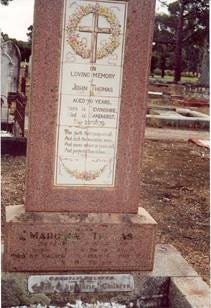
The Clipping
It begins with a short newspaper report describing an unusual monument in Eaglehawk Cemetery:
“The inscription itself is done on tiles… painted before they are baked… quite unique.”
Tucked into the description is a small but intriguing detail: a son of the deceased, while in England, visited a niece who was “very skilful in the work of painting on porcelain tiles.” The tiles are the focus. The niece is not named.
“EAGLEHAWK.
A tombstone of unique design has recently been erected in the Eaglehawk cemetery, over the graves of the late Mr. John Thomas and Mrs. Margaret Thomas, two old residents of California Gully, who died in 1879 and 1897 respectively. Deceased were the parents of Messrs. Michael and Robert Thomas and Mesdames Jas. Taylor, R. Williams and Stevens, and the former gentleman, whilst in England, some 10 years ago, visited a niece who was very skilful in the work of painting on porcelain tiles. He arranged with her to have tiles suitably painted for his father’s grave, and since the death of Mrs. Thomas the work of erecting the tombstone and railing has been carried out. The stone is of Scotch granite, and surrounding the inscription is an appropriate design of a chain with broken link. The inscription itself is done on the tiles, which are inlaid on the face of the granite. A wreath of flowers, nicely painted, and surrounding a cross of gilt, forms the upper portion, and on the tiles, underneath are the usual inscription and a suitable verse. The work on the tiles, which is painted before they are baked, is quite unique. The grave is surrounded by a railing, and the whole forms a very suitable, whilst very novel, form of tombstone.”[1]
What It Suggests
At first glance, the article suggests a story of craftsmanship and family connection:
- A son—likely Michael Thomas—travels back to England around 1890
- He commissions a relative to create something distinctive
- The result is a monument that stands apart from others in the cemetery
The niece appears almost incidental—a convenient explanation for the tiles. But the detail lingers. Who was she?
Looking Closer
The family can be traced through obituaries and records. John and Margaret Thomas, both originally from Cornwall, raised a family that would eventually span two hemispheres. Of their children, most emigrated to Australia, settling in the goldfields around Bendigo and Eaglehawk. One daughter, however, remained behind: Elizabeth (Thomas) Stevens,[2] who stayed in England for many years.
In the 1891 census, Elizabeth is living in London with her daughter:
Sarah Stevens, aged 23, Occupation: tile painter[3]
The connection is striking, the unnamed niece in the newspaper, in England and skilled in painting tiles, now recognisable as Sarah Stevens in England, working as a professional tile painter
The timeline aligns as well:
Around 1890 – the tiles are commissioned[4]
1891 – Sarah is still in London[5]
27 June 1892 – she marries Charles Harper(musician) in St John Church Darlinghurst, Sydney, New South Wales[6]
1895 – she dies, aged just 27[7]
Sarah’s migration to Australia in 1892 brought her to the same country where much of her extended family had already settled, though she appears to have established herself in New South Wales rather than joining her relatives in Victoria. Whether her mother Elizabeth accompanied her or followed later is not recorded. What is clear is that by the time of her death in 1914, Elizabeth had lived in California Gully for some twenty years — meaning she arrived there sometime in the mid-1890s, around the time of Sarah’s death.[8]
What Lies Behind It
The unnamed niece can now be identified as Sarah Stevens, granddaughter of John and Margaret Thomas.
She likely painted the tiles in England before leaving for Australia. It is possible she even carried them with her when she migrated in 1892, ensuring their safe arrival.
But she did not live to see the finished monument. When the headstone was finally erected after Margaret’s death in 1897, Sarah had already been gone for two years.
The most distinctive part of the memorial — the carefully painted tiles set into granite — was created by a young woman whose own life would be cut short, and whose name was never recorded in the newspaper that praised her work. Her mother’s death notice, published nearly two decades later, offers a quiet echo: the Stevens family, connected to London, finally resting in the same soil as the grandparents Sarah had honoured with her craft.
Reflection
Newspaper reports often draw our attention to what is unusual — in this case, the tiles. But it is that small detail of the unnamed “niece” that leads us unexpectedly to Sarah Stevens: a skilled worker in London, a migrant to Australia, a quiet contributor to her grandparents’ memorial.
I first saw the headstone before I knew any of this. Walking through Eaglehawk Cemetery, I noticed its unusual tiled design—so distinctive that its photograph would later appear on the brochure advertising cemetery tours. But at the time, no one I spoke with could explain why it looked the way it did, not even the local historian who marvelled at it. The story behind the tiles was a mystery.
It was only later, coming across a brief newspaper article from 1900, that the pieces began to fall into place. A single line about a “niece” in England, skilled in painting tiles, led me to census records, to migration dates, to a young woman whose name had been forgotten even as her work endured. Finding that clipping was a genuine surprise—the answer to a question I had not yet known to ask.
Sometimes, the smallest detail—a line about painted tiles, a death notice naming a London husband—can carry a story across continents and generations. Sarah’s work was admired by visitors who passed by without knowing her name. Uncovering the newspaper that named her, however faintly, brought her back into the story.
Her work endures, even when the maker is forgotten. But when the maker is remembered, the work speaks differently.
For those interested in learning more about Sarah Jane Stevens' life and family, a detailed profile is available on WikiTree.
Sources
1. 1900 ‘EAGLEHAWK.’, Bendigo Advertiser (Vic. : 1855 - 1918), 4 August, p. 3. , viewed 26 Apr 2020, http://nla.gov.au/nla.news-article89615460
2. Elizabeth Thomas born in 1831 and baptised on 18 September 1832 in St Austell, Cornwall, the daughter of John Thomas (miner) and Margaret Smith residing in Tregonissey. Parish registers for St. Austell: “England, Cornwall Parish Registers, 1538-2010” Parish registers for St. Austell Christenings 1813-1867, Image path: England, Cornwall Parish Registers, 1538-2010 > Cornwall > St Austell > Baptisms, 1826-1839 > image 79 of 414 (FamilySearch Image accessed https://familysearch.org/ark:/61903/3:1:33S7-9RFB-QP2X?cc=1769414&wc=3CBW-DPV%3A138123201%2C140886101%2C140892001 : 20 march 2026)
3. “England and Wales, Census, 1891”, FamilySearch (https://www.familysearch.org/ark:/61903/1:1:Q7Z1-SPZ : Tue Oct 21 06:36:39 UTC 2025), Entry for Elizabeth Stevens and Sarah Jane Stevens, 1891.
4. 1900 ‘EAGLEHAWK.’, Bendigo Advertiser (Vic. : 1855 - 1918), 4 August, p. 3. , viewed 26 Apr 2020, http://nla.gov.au/nla.news-article89615460
5. “England and Wales, Census, 1891”, FamilySearch (https://www.familysearch.org/ark:/61903/1:1:Q7Z1-SPZ : Tue Oct 21 06:36:39 UTC 2025), Entry for Elizabeth Stevens and Sarah Jane Stevens, 1891.
6. Marriage of Sarah Jane Stevens & Charles Harper 1892, Church of St John’s Darlinghurst entry 738, 1892 Sydney, New South Wales, Australia, Anglican Church Diocese of Sydney; Sydney, New South Wales, Australia; Baptism, Burial, Confirmation, Marriage and Composite Registers in the Anglican Church Diocese of Sydney Archives, Sub-registration District: 04 April 1888 - 19 January 1893
7. Death Notice, Jennie Harper, wife of Charles Harper (1895, October 12). The Sydney Morning Herald (NSW : 1842 - 1954), p. 1. Retrieved March 26, 2026, from http://nla.gov.au/nla.news-article14020559
8. 1914 ‘OBITUARY.’, Bendigonian (Bendigo, Vic. : 1914 - 1918), 14 July, p. 19. , viewed 17 Nov 2021, http://nla.gov.au/nla.news-article92044073Comments and corrections are always welcome.

Comments and corrections are always welcome.