Showing posts with label Williamson. Show all posts

Monday, 15 June 2026

One Photograph, Two Recipients

A photograph sent to two women, with two very different meanings

The Sepia Saturday theme this week features a young boy sitting beside a lifebuoy, posing for the camera. Looking at it reminded me of another photograph and another lifebuoy—one that carried a very different story.
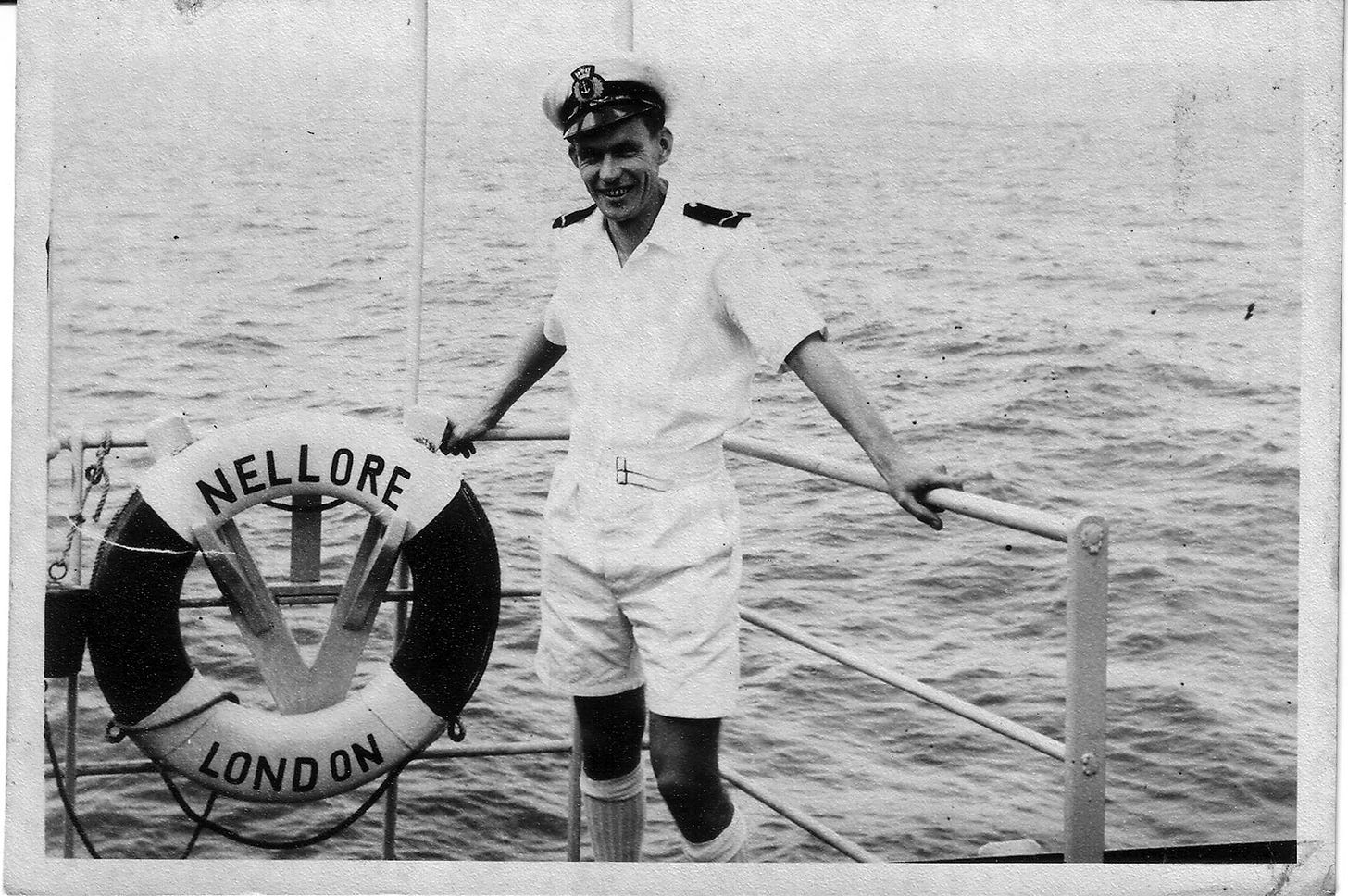
Taken aboard the S.S. Nellore in 1957, this photograph first travelled to John’s wife and later to the woman who would become my mother. [W182]

The photograph shows my father, John Williamson, standing beside a lifebuoy aboard the S.S. Nellore in late 1957.

At the time, John was serving as a Junior Engineer Officer with the Eastern & Australian Steamship Company. The Nellore carried him to ports that must have seemed wonderfully exotic to a young Australian sailor: Manila, Yokohama, Kobe and Yokkaichi. Somewhere during those voyages, someone took this photograph.

What makes the image interesting is not where it was taken, but who eventually received it.

When the photograph was first developed, John was still married. The marriage was failing, though the separation had not yet happened. It is easy to imagine him slipping the photograph into an envelope and posting it home from some distant port. Perhaps he enclosed a letter. Perhaps he didn’t. Either way, the photograph carried a simple message: I am still here. I am still out at sea.

That was the photograph’s first story.

Then came another ship.

After leaving the Nellore, John joined the Monowai, running between Sydney, Wellington and Auckland. It was during one of those Tasman crossings that he met Judy.

What began as a shipboard flirtation—a dance, a shared laugh, a handsome uniform—gradually became something much deeper. John, eleven years older than Judy, soon found himself writing letters full of longing. In one he confessed:

“I still can’t figure whether it was all a dream or whether you are actually real.”

Then, in February 1959, more than a year after the photograph had been taken, he sent Judy the same picture.

The same photograph.

A different story.

But by then the meaning had changed completely.

To his wife, the photograph had been a distant signal from a man trying to work out where his life was heading.

To Judy, it became something more personal. Not a declaration of love. Not a promise of a future together. Simply a quiet plea: Don’t forget me.

By then, what had begun as a holiday romance had become real. John wasn’t asking Judy to build a life with him—not yet. He was simply afraid she might stop thinking about him. So he sent her a photograph from his past and hoped she would carry it into their future.

One photograph.

Two recipients.

Two entirely different stories.

Today, the two photographs have come to rest with the eldest daughters from the first two of John’s three marriages. Neither woman was the original recipient, yet each inherited a photograph that had once carried such personal meaning for her mother. When we eventually realised that our mothers had both received exactly the same photograph, more than a year apart and under very different circumstances, we were astonished. An ordinary shipboard snapshot had quietly preserved a family story that neither of us had known.

The little boy in this week's theme photograph sits beside a lifebuoy, gazing out toward the sea. John stood beside his lifebuoy on a ship's deck—already there. Yet by the time his photograph reached its second recipient, the lifebuoy no longer symbolised rescue or safety. It had become something far more human: a reminder that photographs tell us less about the moment they were taken than about the people who later hold them.

Saturday, 16 May 2026

Case File 2: Carrying the Badge

Three Photographs of Rita Williamson and the Methodist Home Front

This article is part of an ongoing series treating the photographs in my family collection as primary sources — not simply illustrations of family stories, but historical evidence capable of testing, confirming, and sometimes overturning those stories altogether.

Tuesday, 17 June 2025

Inheriting Faith in a Fragmented Religious Landscape (Part 5)

 Legacy of Faith - Conclusions and Reflections

Having explored John Williamson's spiritual inheritance through his parents' diverse religious backgrounds in Parts 1-2, his marriage choices in Part 3, and the influential role of women in Part 4, our final installment examines what we can and cannot know about his personal faith and the broader implications of his story.

Assumptions, Evidence, and Future Research

John Williamson with his wife Margaret circa 1950

In tracing John Williamson's spiritual outlook, I have assumed that his early exposure to structured religion and spiritualist influences shaped his adult beliefs. However, direct evidence of John's personal faith is limited. While military and marriage records list him as affiliated with the Church of Christ, it is unclear whether this reflects active belief or merely social convention. Some living relatives recall no strong religious convictions in John, and his children's church involvement may have stemmed more from their mother's influence.

Given these ambiguities, further research is needed. Interviews with surviving family members and a search for church membership records may clarify John's true stance. I also acknowledge the possibility—raised by my beta reader—that John may have abandoned religious faith altogether, reflecting a broader pattern of secularisation in families exposed to diverse belief systems.

Between Worlds: 

John as a Transitional Figure

John Williamson's life (1892-1957) spanned a period of profound religious change in Australia. Born into a world where religious affiliation was nearly universal, he died at the beginning of what would become a steady decline in formal religious participation. His negotiation between traditions—from his father's structured Christianity to his mother's spiritualist heritage, culminating in his Methodist marriage—makes him a fascinating transitional figure.

Whether John maintained personal religious convictions or merely observed social conventions, his flexibility across denominational lines foreshadowed the more fluid approach to spirituality that would become increasingly common in later generations. In this sense, John's religious journey may be most valuable not as an individual case study but as a window into how faith adapts at the hinge points of cultural change.

What We Learn from Fragmented Faith

What lessons can we draw from John's spiritual inheritance for our contemporary religious landscape? Several insights emerge:

  1. Religious identity is rarely inherited intact. Even in eras of stronger religious affiliation, individuals like John navigated between traditions, adapting faith to circumstance.

  2. Women's influence on religious formation is often invisible in formal records. As we saw in Part 4, the spiritual work of Caroline, Isabella, and Margaret shaped John's religious environment in ways that conventional histories might miss.

  3. Geographic displacement creates religious opportunity and challenge. The Williamson family's move from Victoria to Western Australia forced a renegotiation of religious identity that mirrors many contemporary experiences of migration and displacement.

  4. Religious pragmatism has deep historical roots. John's apparent comfort with interdenominational marriage and flexible affiliation challenges simplistic narratives about a more religiously dogmatic past.

Personal Reflection: 

Why This Matters

This exploration began as genealogical curiosity but evolved into something more profound—a meditation on how we all navigate inherited belief systems. My great-grandfather's spiritual journey, with its pragmatic adaptations and denominational border-crossings, feels remarkably contemporary despite the century that separates us.

In an age where many of us assemble spiritual identities from diverse sources and traditions, John's story reminds us that such religious bricolage is not entirely new. Perhaps what has changed is not the human tendency to adapt faith to circumstance, but merely our willingness to acknowledge doing so.

This uncertainty about John's inner spiritual life does not diminish the value of examining his spiritual inheritance; rather, it highlights the complexity of faith transmission and adaptation across generations—a complexity that continues to shape our religious landscape today.

This concludes the five-part series originally serialised on Blogger. A complete, revised version will soon be published on Substack.

Monday, 2 June 2025

Inheriting Faith in a Fragmented Religious Landscape (Part 3)

Vows and Voices of the Past

This is the third of a five-part serialised essay that traces the spiritual inheritance of my great-grandfather JohnWilliamson.

While Part 2 revealed the religious diversity that shaped John's early faith, in Part 3,  we shift to a pivotal moment in John’s life: his marriage

Marriage, Methodism, and Making Faith Work

Wedding Photo of John Palmer Williamson & Margaret Edith Jacka 1922


In 1922, John married Margaret Edith Jacka, a woman from a Methodist family in Hamilton, Victoria. The ceremony, held in a Methodist Church and officiated by Rev. James Sweetnam Thomas, reveals John’s adaptability:

  • Respecting his wife's tradition

  • Practising interdenominational flexibility or perhaps lacking any firm religious conviction of his own

  • Embracing religious unity without erasing individual conviction

This choice mirrored the open, pragmatic spirit of his parents and the fluid religious identity shaped by his upbringing.

The Minister as Mirror: What Rev. Thomas Reveals About John's Choices

The minister who joined John and Margaret in matrimony provides a fascinating window into the religious world they were navigating. Rev. James Sweetnam Thomas (c.1869–1927) was not merely an officiant but a significant spiritual figure in New South Wales, described in his obituary as "one of the best known clergymen in N.S.W."

Born into a devout Methodist family with a father honoured for fifty years of lay preaching, Thomas represented the established Methodist tradition that Margaret brought to the marriage. His reputation for patience, kindness, and pastoral dedication suggests why the couple might have chosen him to officiate their union. As a "special preacher" who crossed denominational lines (having preached at Baptist churches), Thomas embodied the kind of interdenominational flexibility that John's own family history had prepared him to value.

What would a wedding ceremony by Rev. Thomas have meant for John, a man raised in the Church of Christ tradition? Given Thomas's reputation as a "faithful pastor" with a "calm and patient spirit," the ceremony likely emphasised the spiritual foundations of marriage rather than rigid denominational boundaries. This aligns perfectly with John's apparent approach to faith—practical, adaptive, yet grounded in inherited Christian values.

Methodist Marriage in Context

The 1922 Methodist wedding ceremony would have been relatively simple compared to Anglican or Catholic traditions of the time, focusing on the spiritual covenant rather than elaborate ritual. This simplicity would have resonated with John's Church of Christ background, which similarly emphasised scriptural purity and unadorned worship.

For John, a returned WWI soldier who had listed "Church of Christ"i on his military records just years earlier, choosing a Methodist ceremony represented more than mere convenience. It demonstrated a willingness to bridge denominational differences that reflected his own complex religious inheritance—a father who moved from Christian Israelite to Freemasonry, and a mother with ties to Spiritualism.

In this pivotal life decision, we see John enacting the very pattern of religious adaptation that defined his family's approach to faith across generations—honouring tradition while responding pragmatically to new circumstances and relationships.

🗄️ Sources for the Minster:

  1. Fifty Years a Local Preacher. (1906, October 26). The Methodist (Sydney, NSW : 1892 - 1954), p. 6. Retrieved May 4, 2025, from http://nla.gov.au/nla.news-article155456692 [Explanation: father Thomas Henry receiving an award for his work in the Methodist Church in Orange, confirms that he is the father of Rev J. Sweetnam Thomas, of Uralla]

  2. Correspondence. (1906, June 23). The Uralla News (NSW : 1904 - 1907), p. 2. Retrieved May 4, 2025, from http://nla.gov.au/nla.news-article185478855 [Explanation: He talks about his moral convictions as he refrained from actions based on conscientious reasons, he was also speaking up and supporting people he thought had been maligned by an anonymous person.]

  3. REV. J. SWEETNAM THOMAS. (1927, March 9). The Sydney Morning Herald (NSW : 1842 - 1954), p. 20. Retrieved May 4, 2025, from http://nla.gov.au/nla.news-article16360013 [Explanation: Obituary outlining his career and his belief in the Temperance.]

  4. LATE REV. J. S. THOMAS (1927, March 9). The Labor Daily (Sydney, NSW : 1924 - 1938), p. 6. Retrieved May 4, 2025, from http://nla.gov.au/nla.news-article239930702 [Explanation: Claims he was one of the best known clergymen in N.S.W. article also refers to his daughter who became demonstrator in zoology at the Sydney University, demonstrating his believe in supporting women as full participants in society not just the home.]

Footnotes

i John Palmer Williamson (service number 10030), WWI Service record, page 7 of 29 National Archives of Australia, Series number B2455, Item ID 8389870 (accessed at https://recordsearch.naa.gov.au/SearchNRetrieve/Interface/ViewImage.aspx?B=8389870 : 11 May 2025)

Sunday, 25 May 2025

Inheriting Faith in a Fragmented Religious Landscape (Part 2)

Mapping a Fragmented Faith

This is the second of a five-part serialised essay that traces the spiritual inheritance of my great-grandfather John Williamson.

Having established in Part 1 how John Williamson's spiritual journey reflects our modern struggles with religious identity—navigating diverse family traditions while forging personal meaning in changing social contexts—we now turn to mapping the specific religious landscape that shaped his faith inheritance.

The following timeline provides a chronological overview of key religious events and affiliations across three generations. Before exploring the details of John Williamson's religious heritage, the following timeline provides a chronological overview of key religious events and affiliations across three generations. This visual representation helps illustrate how faith evolved through Moses and Caroline's diverse spiritual backgrounds, ultimately shaping the religious context in which John was raised.

Wednesday, 21 May 2025

Inheriting Faith in a Fragmented Religious Landscape (Part 1)

Part 1: A Religious Inheritance

This serialised essay traces the spiritual inheritance of my great-grandfather John Williamson, revealing how faith was shaped by family traditions, migration, and changing religious landscapes in colonial and early 20th-century Australia. It explores:

  • The contrasting religious backgrounds of John’s parents: Moses, a structured Christian seeker, and Caroline, raised in a Spiritualist household.

  • How John’s early life in York, Western Australia, influenced his adoption of the Church of Christ.

  • The significance of John’s interdenominational marriage and his adult faith choices.

  • Broader reflections on how faith is inherited, adapted, and negotiated across generations.

This is the first in a five-part series exploring the spiritual inheritance of my great-grandfather, John Williamson, and the fragmented religious world he navigated.

Photo by MARIOLA GROBELSKA on Unsplash

A Legacy of Faith: Framing the Family Story

When exploring my great-grandfather John Williamson's spiritual journey through colonial Australia, I discovered a remarkable parallel to our contemporary struggles with religious identity. Though separated by more than a century, the challenges he faced resonate powerfully today: navigating diverse family traditions, transplanting faith to new environments, and forging personal meaning when inherited beliefs meet changing social contexts.

In today's world of declining religious affiliation and more personalised belief systems, many of us experience unprecedented freedom—and uncertainty—in our spiritual lives. John's story offers a compelling historical lens through which to examine this modern condition. His experience at the intersection of structured religion and metaphysical exploration demonstrates how faith identity is not simply inherited but actively negotiated through family influence, geographical circumstance, and personal conviction.

This series traces the religious journey of four generations of my family, focusing on John Williamson as a case study in spiritual adaptation. Using a hermeneutic approach inspired by the article "Devout: Were Our Ancestors 'Godly'?" (Mightier Acorns, May 3, 2025), I aim to understand not just what my ancestors practised, but what they believed—and how those beliefs shaped their relationships, migrations, and communities. By examining both religious records and the social contexts in which they lived, I hope to illuminate the complex ways faith transforms when transplanted to new soil, constrained by practical realities, and enriched by diverse influences.

Next: Part 2: Mapping a Fragmented Faith

Saturday, 12 October 2024

Finding Clues in Unusual Places

On 27 April 1901, Louisa Williamson was interviewed about the health benefits of Clements Tonic. This interview became one of the many testimonials the company producing Clements Tonic used to market its product. Louisa signed a Statutory Declaration attesting that the Tonic had cured her of illness and that she received no payment for her testimonial.

1903 'Advertising', The Age (Melbourne, Vic. : 1854 - 1954), 23 May, p. 14. , viewed 12 Oct 2024, http://nla.gov.au/nla.news-article197223637

The interview helped to furnish the following details about Louisa’s life:

She was living at 62 Harmsworth Street, Collingwood. which on investigation is the same address where her youngest living daughter, Phoebe Brooks, was residing with her husband Henry.[i] Before April 1901, she had been feeling poorly and had gone to Bulli in New South Wales for respite. Bulli is also where her eldest daughter, Rachael Croft, lived with her second husband.[ii] On the return journey home, she experienced a severe bout of illness which continued after she returned home to St Kilda. It seemed nothing could be done until someone recommended that she take Clements Tonic after which she began to feel better. As she got better, she moved to live with her daughter Phoebe where the interview took place.

In essence, the interview reveals the following details:

  •          On 27 April 1901, she was residing at 62 Harmsworth street, Collingwood
  •      She had lived in St Kilda for many years before moving to Collingwood
  •         While living in St Kilda she went on a trip to Bulli, New South Wales
  •          It was not until after her trip to Bulli that she moved from St Kilda to Collingwood

Louisa died (an old pensioner of 72 years of age) on 6 September 1901, three months after the interview, of an umbilical hernia, uncontrollable vomiting and exhaustion.[iii]

Although not published before her death, the Testimonial continued being published until February 1904. 

Useful links for background

WikiTree profile for Louisa (Walker) Williamson (1828 - 1901)

See below for links to original copies of the published Testimonial.

Blogpost Meta Data

The URL for this post is:  https://ancestralresearchjournal.blogspot.com/2024/10/finding-clues-in-unusual-places.html Originally published on 12 October 2024

Please comment on this post on the website by clicking the URL above and then the "Comments" link at the bottom of each post. Share it on Twitter/X, Facebook, or Pinterest using the icons below. Or contact me by email via the Contact Form on the Blog.

Copies of the Testimonial can be found in the following newspapers:

1901 'Advertising', South Bourke and Mornington Journal (Richmond, Vic. : 1877 - 1920; 1926 - 1927), 7 August, p. 4. (WEEKLY.), viewed 11 Oct 2024, http://nla.gov.au/nla.news-article70047585

1901 'Advertising', South Bourke and Mornington Journal (Richmond, Vic. : 1877 - 1920; 1926 - 1927), 6 November, p. 4. (WEEKLY.), viewed 11 Oct 2024, http://nla.gov.au/nla.news-article70047918

1902 'Advertising', The Age (Melbourne, Vic. : 1854 - 1954), 1 March, p. 13. , viewed 11 Oct 2024, http://nla.gov.au/nla.news-article197258709

1902 'Advertising', South Bourke and Mornington Journal (Richmond, Vic. : 1877 - 1920; 1926 - 1927), 7 May, p. 4. (WEEKLY.), viewed 11 Oct 2024, http://nla.gov.au/nla.news-article70048612

1902 'Advertising', The Age (Melbourne, Vic. : 1854 - 1954), 21 June, p. 14. , viewed 11 Oct 2024, http://nla.gov.au/nla.news-article199399115

1902 'Advertising', South Bourke and Mornington Journal (Richmond, Vic. : 1877 - 1920; 1926 - 1927), 6 August, p. 4. (WEEKLY.), viewed 11 Oct 2024, http://nla.gov.au/nla.news-article70048957

1902 'Advertising', South Bourke and Mornington Journal (Richmond, Vic. : 1877 - 1920; 1926 - 1927), 5 November, p. 4. (WEEKLY.), viewed 11 Oct 2024, http://nla.gov.au/nla.news-article70049247

1902 'Advertising', The Age (Melbourne, Vic. : 1854 - 1954), 11 October, p. 13. , viewed 11 Oct 2024, http://nla.gov.au/nla.news-article187621752

1903 'Advertising', The Age (Melbourne, Vic. : 1854 - 1954), 31 January, p. 17. , viewed 11 Oct 2024, http://nla.gov.au/nla.news-article197897754

1903 'Advertising', The Age (Melbourne, Vic. : 1854 - 1954), 23 May, p. 14. , viewed 11 Oct 2024, http://nla.gov.au/nla.news-article197223637

1903 'Advertising', The Age (Melbourne, Vic. : 1854 - 1954), 12 September, p. 17. , viewed 11 Oct 2024, http://nla.gov.au/nla.news-article189343355

1904 'Advertising', The Age (Melbourne, Vic. : 1854 - 1954), 13 February, p. 17. , viewed 11 Oct 2024, http://nla.gov.au/nla.news-article197229004

Additional Sources:


[i] Melbourne Directory (Sands) 1900, page 232, entry for Henry Brooks residing at 62 Harmsworth st, Collingwood, page 232

[ii] '''Birth Registration of Hiram Croft (grandson)''': "New South Wales Births, Deaths and Marriages"Birth Registration Number: 38358/1894; District: Woonona; [https://familyhistory.bdm.nsw.gov.au/lifelink/familyhistory/search/births Births search page] (accessed 11 October 2024) citing Hiram Croft birth registered 1894 in New South Wales, Australia, son of George & Rachel.

[iii] Registry of Birth, Death and Marriages, Victoria, Australia, Death Certificate Louisa Williamson, (Year 1901, Reference #9613)

Saturday, 11 April 2020

Thomas Williamson born 1855 Victoria Australia


Thomas Williamson was born on 11 January 1855 in Melbourne, Victoria, Australia, the eldest son of John Williamson and Lousia Walker.[i]

He became a professional tailor like his father before him, and his two younger brothers became tailors as well. His father died when he was only nineteen years old in 1874, leaving his widowed mother sole provider for seven children.[ii] His mother held onto his father’s shop until 1878 then sold it.[iii]

His three sisters, Rachael, Miriam, and Phoebe all married. They and their three families joined the sect known as Israelite House of David and emigrated to Benton Harbor, Michigan, USA in 1905, 1906 and 1912(?).[iv] [v] Thomas did not join the sect nor is it thought that he immigrated to the US.
Thomas married Mary Ann McCoy on 5 June 1876 in the Congregational Church, in St. Kilda, Victoria.[vi]

The couple had four children but, according to Mary Ann’s death certificate, she herself had five children. The fifth child is yet to be identified, and may not be Thomas’s child. The recorded children of the marriage were Alfred John born 1879 in St. Kilda; Ethel b. 1882 and Florence b. 1883 both born in Emerald Hill (Sth. Melbourne); and George Tasman Williamson born 1886 in Launceston, Tasmania.[vii] [viii] [ix] [x]

After their marriage, the couple lived in various inner Melbourne suburbs before moving to Tasmania for a few years, where their son George Tasman was born. [xi]  After that, the next known address for Thomas was in Havelock St, St Kilda West, in 1888.[xii]

Not much is known about Thomas except that his marriage appears to have disintegrated as the couple fell on hard times, and as a result, they both went their own ways and abandoned the children.[xiii] [xiv] Their two younger children, Florence and George, went into care on 2 October 1890 and eventually both went to live with Mrs Middleton in North Geelong, Victoria.[xv] [xvi] Their elder sister Ethel lived first with her Aunt Rachel (Mrs McFarlane), then her other Aunt Phoebe (Mrs Brooks). Where their elder son went to live is not known.

Six years later, in 1896, Thomas’ estranged wife, who had been living as Mrs Marion Robertson, died in Bourke New South Wales from the effects of poisoning.[xvii] Amongst her belongings was correspondence from a Thomas Williamson, tailor, residing in Young, NSW. [xviii]

Where or what Thomas did after 1896 is not yet known.


[i] Registry of Birth, Death and Marriages, Victoria, Australia, Birth Certificate Thomas Williamson 218/1855
[ii] Registry of Birth, Death and Marriages, Victoria, Australia, Death Certificate John Williamson, died 7 June 1874, Saint Kilda, Victoria, Australia, 6427/1874
[iii] Vendors Books, Victoria (Land Victoria (Natural Resources and Environment)), Memorial 275 Book 167.
[iv] "California, San Francisco Passenger Lists, 1893-1953," database with images, FamilySearch (https://familysearch.org/ark:/61903/1:1:QV1W-WD6G : 12 March 2018), Passenger List for Sonoma, 1906 arriving San Francisco, San Francisco, California, United States; citing San Francisco, San Francisco, California, United States, NARA microfilm publication M1410 (Washington, D.C.: National Archives and Records Administration, n.d.); FHL microfilm 1,465,588.
[v] "New York Passenger Arrival Lists (Ellis Island), 1892-1924", database with images, FamilySearch (https://familysearch.org/ark:/61903/1:1:JF3D-KX3 : 20 August 2019), Passenger List for the Prinzess Irene departing Genoa arriving Ellis Island, New York, 5 March 1905. (GS Film Number: 1399232, Digital Folder Number: 005262965, Image Number: 00025)
[vi] Registry of Birth, Death and Marriages, Victoria, Marriage Certificate Thomas Williamson & Mary Anne McCoy, 5 June 1876, St Kilda, 2242/1876
[vii] Registry of Birth, Death and Marriages, Victoria, Australia, Birth Certificate Alfred John Williamson, born 2 August 1879, Saint Kilda, Victoria, Australia, 19657/1879
[viii] Registry of Birth, Death and Marriages, Victoria, Australia, Birth certificate Ethel Williamson, born 22 October 1882, 22789/1882
[ix] Registry of Birth, Death and Marriages, Victoria, Australia, Birth Certificate Florence Williamson, 23 November 1883, 23056/1883
[x] Birth record for George Tasman born 28 May 1886 in Launceston, Australia, son of Thomas Williamson & Mary Ann McCoy, entry 2931 Libraries Tasmania's Online collection, NAME_INDEXES:1123903, citing RGD33/1/65 no 345 [image 33] accessed 5 April 2020
[xi] Birth record for George Tasman born 28 May 1886 in Launceston, Australia, son of Thomas Williamson & Mary Ann McCoy, entry 2931 Libraries Tasmania's Online collection, NAME_INDEXES:1123903, citing RGD33/1/65 no 345 [image 33] accessed 5 April 2020
[xii] Voters' Roll for the West Ward of the Borough of St. Kilda 1888, entry for Thomas Williamson, cutter entry 800, page 18, (accessed 1 April 2020 https://issuu.com/copponline/docs/1888_west_ward)
[xiii] Ancestry.com. Victoria, Australia, Police Gazettes, 1855, 1864-1924 [database on-line]. Provo, UT, USA: Ancestry.com Operations, Inc., 2016. Entry for Thomas Williamson for warrant with deserting his wife at Richmond in October, 1889, third  last entry on page 182 in right hand column, June 11, 1890; Original data: Victoria Police Gazette Indexes. CD-ROM. Ridgehaven, South Australia: Gould Genealogy and History, 2009. AU7103-1890 Victoria Police Gazette 1890 [image 218 of 474]
[xiv] Ancestry.com. Victoria, Australia, Police Gazettes, 1855, 1864-1924 [database on-line]. Provo, UT, USA: Ancestry.com Operations, Inc., 2016. Entry for Thomas Williamson, tailor aged 35years, last entry on page 317 in left hand column, October 8, 1890; Original data: Victoria Police Gazette Indexes. CD-ROM. Ridgehaven, South Australia: Gould Genealogy and History, 2009. AU7103-1890 Victoria Police Gazette 1890 [image 362 of 474]
[xv] Entry for Florence Williamson committed 2 October 1890, in the Ward Registers, registration #17741, VPRS 4527/P0002/Vol 11/page 121 (accessed prov.vic.gov.au 2 April 2020)
[xvi] Entry for George Williamson committed 2 October 1890, in the Ward Registers, registration #17740, VPRS 4527/P0002/Vol 11/page 120 (accessed prov.vic.gov.au 2 April 2020)
[xvii] Registry of Birth, Death and Marriages, New South Wales, Australia, Death Certificate Mary Ann Williamson,  died 19 January 1896 Bourke, 110/1896
[xviii] 1896 'THE TERRIBLE HEAT CONTINUES', Western Herald (Bourke, NSW : 1887 - 1970), 22 January, p. 2. , viewed 03 Apr 2020, http://nla.gov.au/nla.news-article104104681

Monday, 30 March 2020

Moses Williamson Born 1863 Victoria Australia


Photographer unknown, Portrait Moses Williamson, circa 1911, John Palmer Williamson's Private Photo Collection, His son John was known as Palmer [his second name during his teens, photo was possibly given to his son when he left home] [W006] 
Moses was born on 17 September 1863 in Saint Kilda, Victoria, Australia, the son of John Williamson and Lousia Walker.[i]

His siblings were born in Victoria, Australia as follows: Thomas Williamson born 1855 in Melbourne; Rachel Williamson born 1857, Miriam Williamson born 1859 and Phebe Williamson born 1861 in Collingwood; Lydia Williamson born 1866 and Aaron Williamson born 1869 in Saint Kilda.

Moses a professional tailor was running his own tailor shop at 25 in Burwood rd., Glenferrie, Hawthorn, Victoria.[ii] His father had been a professional tailor as was his older brother Thomas and younger brother Aaron.[iii] [iv] His father died when Moses was only ten years old.[v]
Moses married Caroline Munro on 16 December 1885 in Fitzroy, Victoria, Australia.[vi]

Photographer unknown, Family portrait of the Williamson family, circa 1907, Western Australia. From Left to right: Harry Williamson, Moses Williamson, Monty Williamson, Cuthbert Williamson, Phoebe Williamson, Caroline Williamson(nursing Norma) and John Williamson(Jack) [W135]

He and Caroline had the following children in Australia, those born in Victoria were Richard Montague Williamson born 1866 in Melbourne and Phoebe Dorothy Williamson born 1890 in Hawthorn; those born Western Australia in York were John Aaron Palmer Williamson born 1892, Henry Andrew Williamson born 1895, Cuthbert Moreton Williamson born 1896; their last child, Norma Williamson born 1906, was born in Fremantle Western Australia.

Moses moved his family to Western Australia in 1890 possibly seeking land and maybe gold as he had shares in a mining company.[vii] [viii] [ix] [x] [xi]  He continued to work as a Tailor in Perth, York and Yarloop.[xii] [xiii]  Moses became a member of the Freemasons in 1888 while living in Victoria and transferred his membership when he relocated to York 1893.[xiv] [xv] [xvi]  He was elected as Councillor in the South Ward of York around 1893.[xvii] As a nurseryman, he ran the Glenferrie Apiary in York.[xviii] [xix]

After 1920 Moses move to Hamilton in New South Wales possibly motivated by ill health.[xx] [xxi]
Moses died on 25 June 1933 in Hamilton New South Wales, and was buried on the following day in Sandgate General Cemetery, New South Wales.[xxii] [xxiii]

Moses Williamson on WikiTree

[i] Birth Certificate Moses Williamson (Births Registered in the District of St Kilda in the Colony of Victoria Certified Copy Registry of Birth, Death and Marriages, Victoria, Australia Year 1863, Number 23188)
[ii] 1888 'Advertising Situations Vacant', Advertising for staff, The Age (Melbourne, Vic. : 1854 - 1954), 10 July, p. 8., viewed 30 Mar 2020, http://nla.gov.au/nla.news-article196001857
[iii] Registry of Birth, Death and Marriages, Victoria, Australia, Marriage Certificate Thomas Williamson & Mary Anne McCoy, 5 June 1876, 2242/1876 occupation listed for Thomas was tailor
[iv] Registry of Birth, Death and Marriages, Victoria, Australia, Death Certificate Aaron Williamson, died 20 November 1891, Saint Kilda, Victoria, Australia, 15639/1891
[v] Registry of Birth, Death and Marriages, Victoria, Australia, Death Certificate John Williamson, died 7 June 1874, Saint Kilda, Victoria, Australia, 6427/1874
[vi] Registry of Birth, Death and Marriages, Victoria, Australia, Marriage Certificate Moses Williamson & Caroline Munro 7312/1885
[vii] According to Moses’ grandson, John Williamson, the family went to WA in the hopes of picking up a land grant but was not successful in doing so.
[viii] 1890 'Classified Advertising', Listed as a shareholder in ‘The No. 1 Central Extended Gold Mining Dompany’, The West Australian (Perth, WA : 1879 - 1954), 18 December, p. 2. , viewed 30 Mar 2020, http://nla.gov.au/nla.news-article3139290
[ix] Birth Certificate of Phoebe Dorothy Williamson, born 27 February 1890. Registrar of Births Deaths and Marriages Victoria, Australia, 4302/1809; Registry of Birth, Death and Marriages, Western  Australia, Death Certificate Pheobe Dorothy Williamson (Year 1911, Reference #) [Pheobe born in Melbourne but only lived their for 6 weeks before going to WA.]
[x] Anon, 'Judicial and Law Notices', The Argus, 10 April 1890, p. 3. , viewed 14 May 2017, http://nla.gov.au/nla.news-article8599718
[xi] 1890 'Classified Advertising', The West Australian (Perth, WA : 1879 - 1954), 18 June, p. 2. , Announcement of a New Department for Tailoring employing Mr Williamson, viewed 29 Mar 2020, http://nla.gov.au/nla.news-article3134977
[xii] 1891 'Advertising', “Announcement that M Williamson opening up a new business in York’ Eastern Districts Chronicle (York, WA : 1877 - 1927), 7 February, p. 4. , viewed 30 Mar 2020, http://nla.gov.au/nla.news-article148137170
[xiii] 1910 'Advertising', Feature advertisement for The Local Tailor of Yarloop, South Western Advertiser (Perth, WA : 1910 - 1954), 23 November, p. 4. , viewed 30 Mar 2020, http://nla.gov.au/nla.news-article149940513
[xiv] Library and Museum of Freemasonry; London, England; Membership entry of Moses Williamson aged 25, tailor member of the Victoria Lodge, Hawthorn Victoria, initiated 13 November 1888mFreemasonry Membership Registers; Description: Membership Registers: Colonial and Foreign I 1788-1919 to Colonial and Foreign J 1923-2037; Reel Number: 27, Lodge Number 2009, Folio Number 251
[xv] Ancestry.com. England, United Grand Lodge of England Freemason Membership Registers, 1751-1921 [database on-line]. Provo, UT, USA: Ancestry.com Operations, Inc., 2015.; Membership entry for Moses Williamson Initiated 5 October 1892, York Lodge, Western Australia, Lodge 2118, year 1892, folio 214, line 31; Citing Original data: Membership registers 1751-1921 from the collection of the United Grand Lodge of England held by the Library and Museum of Freemasonry. Images reproduced by courtesy of the Library and Museum of Freemasonry, London.
[xvi] 1892 'GENERAL NEWS.', Eastern Districts Chronicle (York, WA : 1877 - 1927), 26 March, p. 5, Col 2. , viewed 20 Jun 2019, http://nla.gov.au/nla.news-article148590374
[xvii] 1893 'GENERAL NEWS.', Eastern Districts Chronicle (York, WA : 1877 - 1927), 8 April, p. 2. , viewed 30 Mar 2020, http://nla.gov.au/nla.news-article148498169
[xviii] 1897 'Advertising', “Asking for Pickle bottles” Eastern Districts Chronicle (York, WA : 1877 - 1927), 13 November, p. 4. , viewed 30 Mar 2020, http://nla.gov.au/nla.news-article148266686 [possibly for the bottling of honey]
[xix] 1912 'Advertising', “Selling off Old Hives of Bees” The West Australian (Perth, WA : 1879 - 1954), 21 February, p. 12. , viewed 30 Mar 2020, http://nla.gov.au/nla.news-article23865054
[xx] 1917 'Personal.', Gossip column refers to Mr Moses Williams ill health, South Western Times (Bunbury, WA : 1917 - 1929), 21 July, p. 5. , viewed 30 Mar 2020, http://nla.gov.au/nla.news-article214191890
[xxi] Australian Electoral Rolls, 1901-1936 ([database on-line]. Provo, UT, USA: The Generations Network, Inc., 2007. Original data: Australian Electoral Commission. [Electoral roll]. Microform mc N 451-mc N 457. National Library of Australia, Canberra, Australia.), Entry for Moses Williamson Westcombe, Coolah road, Hamilton, master tailor, Electoral Year: 1930, State: New South Wales, District: Newcastle, Subdistrict: Hamilton page 143.
[xxii] Registry of Birth, Death and Marriages, New South Wales, Australia, Death certificate Moses Williamson, died 25 June 1933, Hamilton, New South Wales, Australia, 10306/1933
[xxiii] Northern Cemeteries, Moses Williamson buried 26 June 1933 in Sandgate Cemetery, Newcastle, New South Wales, Australia. https://nmclm.com.au/  accessed 30 March 2020 [unmarked gravesite located at GENERAL, 34A, GENERAL-34A-52]