
A photograph sent to two women, with two very different meanings
The Sepia Saturday theme this week features a young boy sitting beside a lifebuoy, posing for the camera. Looking at it reminded me of another photograph and another lifebuoy—one that carried a very different story.
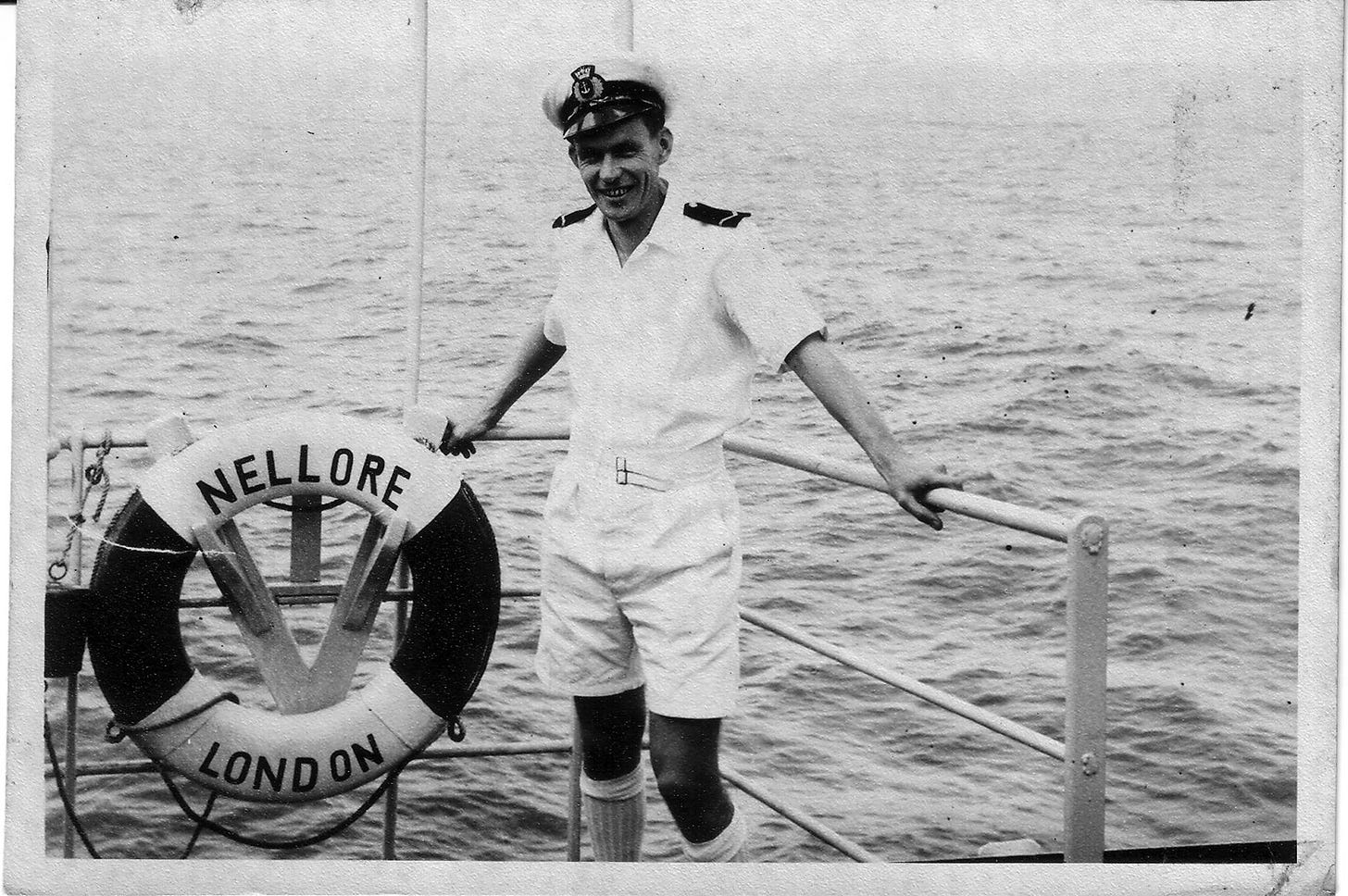 |
| Taken aboard the S.S. Nellore in 1957, this photograph first travelled to John’s wife and later to the woman who would become my mother. [W182] |
The photograph shows my father, John Williamson, standing beside a lifebuoy aboard the S.S. Nellore in late 1957.
At the time, John was serving as a Junior Engineer Officer with the Eastern & Australian Steamship Company. The Nellore carried him to ports that must have seemed wonderfully exotic to a young Australian sailor: Manila, Yokohama, Kobe and Yokkaichi. Somewhere during those voyages, someone took this photograph.
What makes the image interesting is not where it was taken, but who eventually received it.
When the photograph was first developed, John was still married. The marriage was failing, though the separation had not yet happened. It is easy to imagine him slipping the photograph into an envelope and posting it home from some distant port. Perhaps he enclosed a letter. Perhaps he didn’t. Either way, the photograph carried a simple message: I am still here. I am still out at sea.
That was the photograph’s first story.
Then came another ship.
After leaving the Nellore, John joined the Monowai, running between Sydney, Wellington and Auckland. It was during one of those Tasman crossings that he met Judy.
What began as a shipboard flirtation—a dance, a shared laugh, a handsome uniform—gradually became something much deeper. John, eleven years older than Judy, soon found himself writing letters full of longing. In one he confessed:
“I still can’t figure whether it was all a dream or whether you are actually real.”
Then, in February 1959, more than a year after the photograph had been taken, he sent Judy the same picture.
The same photograph.
A different story.
But by then the meaning had changed completely.
To his wife, the photograph had been a distant signal from a man trying to work out where his life was heading.
To Judy, it became something more personal. Not a declaration of love. Not a promise of a future together. Simply a quiet plea: Don’t forget me.
By then, what had begun as a holiday romance had become real. John wasn’t asking Judy to build a life with him—not yet. He was simply afraid she might stop thinking about him. So he sent her a photograph from his past and hoped she would carry it into their future.
One photograph.
Two recipients.
Two entirely different stories.
Today, the two photographs have come to rest with the eldest daughters from the first two of John’s three marriages. Neither woman was the original recipient, yet each inherited a photograph that had once carried such personal meaning for her mother. When we eventually realised that our mothers had both received exactly the same photograph, more than a year apart and under very different circumstances, we were astonished. An ordinary shipboard snapshot had quietly preserved a family story that neither of us had known.
The little boy in this week's theme photograph sits beside a lifebuoy, gazing out toward the sea. John stood beside his lifebuoy on a ship's deck—already there. Yet by the time his photograph reached its second recipient, the lifebuoy no longer symbolised rescue or safety. It had become something far more human: a reminder that photographs tell us less about the moment they were taken than about the people who later hold them.
What an interesting divisional story about one single photograph! He was very handsome. :)
ReplyDeleteGreat story about the two versions of the same photo, going eventually to his two daughters. You wrote it very well, to help us understand the differences of meanings in his sharing it with the women who were both to be his wives.
ReplyDeleteI liked this story how you showed a gift of a photo can have more than one meaning between the giver and their recipients. I imagine that back in the olden days when the number of photo prints were limited, a giver had to decide who would get one. Over her long life my grandmother received countless photos of children from friends and family. She saved ever one, often writing the child's name and date on the back. For many she kept track of their birthdays, too, and would send them a card, even though she likely would never meet them. I think of her whenever I acquire a photo that has an annotation that reflects that memento quality of a portrait as a gift. Our modern smartphone snaps don't have that same power.
ReplyDelete